
Concrete Mixing and Pumping for Construction 3D Printing
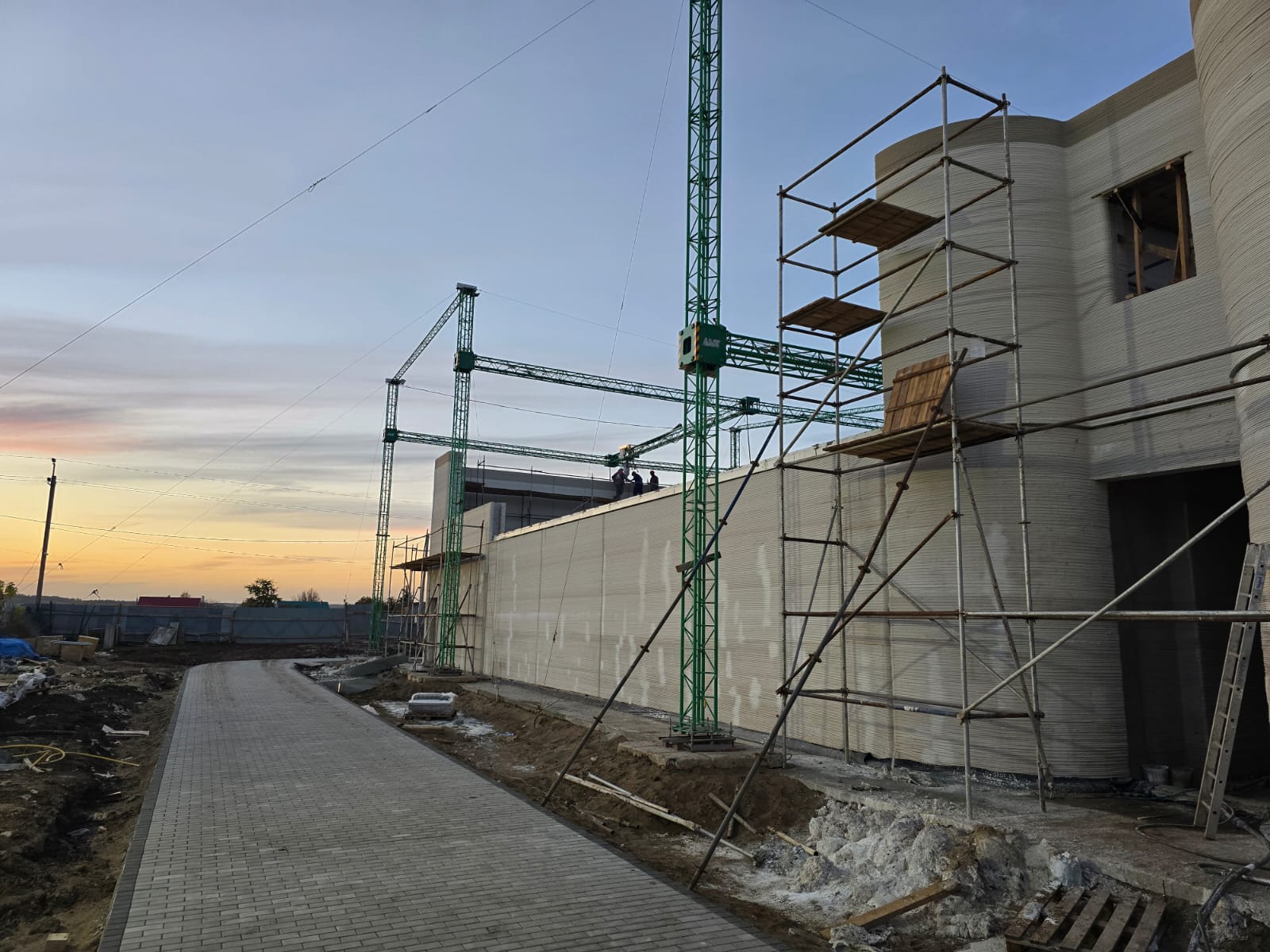
Construction 3D printing depends on a stable material-delivery workflow. The printer controls motion, but the synchronized mixer and pump must prepare and deliver a consistent printable cement-based mixture to the print head at the required rate.
If mixing, pumping, hose routing, or extrusion is unstable, accurate machine movement alone cannot produce consistent layers. For this reason, AMTG treats the printer, mixer, pump, controls, and power supply as parts of one coordinated equipment system.
The role of the synchronized mixer
The mixer prepares material according to the qualified production procedure. Its purpose is to create repeatable batches or a controlled continuous supply with the consistency required by the selected pump, hose system, print head, layer geometry, and operating environment.
AMTG has developed proprietary construction-printing recipes with options that differ by setting time, color, aggregate fraction, plasticity, pumpability, and layer stability. The appropriate recipe and operating parameters are selected around the intended application, equipment, production rate, and environmental conditions, then verified for the actual project.
The role of the material pump
The pump moves prepared material from the mixing system through the delivery line to the print head. It must provide a controllable flow that matches the printer’s motion, target bead dimensions, layer height, and planned production rate.
The required pump configuration depends on the printable mixture, delivery distance, hose diameter and routing, elevation change, print-head design, expected output, and the customer’s cleaning and maintenance procedures. A pump cannot be selected only by its maximum advertised capacity.
Why synchronization matters
The printing system and material-delivery system must operate as one process. Printer movement without sufficient material can create narrow or interrupted layers. Excessive flow can produce oversized beads, loss of geometry, or material accumulation. Stops and restarts must also be coordinated with the material’s working time and the planned toolpath.
- Printer speed must correspond to the required material flow
- Pump output must support the planned layer width and height
- Mixing capacity must sustain the intended production cycle
- Toolpaths must account for starts, stops, corners, openings, and transitions
- Operators must monitor both machine motion and extrusion quality
For an overview of the complete process, read How Construction 3D Printing Works.
Hose routing and delivery distance
The delivery line connects the pump to the moving print head. Hose length, diameter, bends, elevation, support, movement, and cleaning access influence resistance and operating stability. The routing must avoid interfering with machine motion, printed walls, personnel, reinforcement, and other site or factory operations.
Longer or more complex delivery routes may change the required pump performance and operating procedure. Hose behavior must therefore be considered during equipment layout and print planning, not after the machine has already been positioned.
The print head and extrusion bead
The print head forms the delivered material into the intended bead. Nozzle geometry, extrusion control, travel speed, layer dimensions, and material behavior determine how each layer is placed and how it supports the next layer.
Operators monitor continuity, bead width and height, layer alignment, corners, surface behavior, starts, and stops. Adjustments must remain within the customer’s qualified material and printing procedure.
Power supply and generator
The printer, mixer, pump, controls, auxiliary equipment, and cleaning systems require a planned power supply. Depending on the agreed configuration, AMTG can provide a power generator selected for the supplied equipment package.
The customer must also consider operating loads, startup loads, cable routing, grounding, environmental protection, fuel or electrical service, backup procedures, and applicable local safety requirements. Final electrical installation remains under the control of qualified professionals.
Cleaning and process control
Cement-based material cannot be left uncontrolled inside mixers, pumps, hoses, or print heads. The operating plan must include cleaning access, water and waste management, shutdown procedures, restart procedures, inspection, and maintenance.
Production records can include batch information, environmental conditions, machine settings, pump settings, print times, interruptions, and quality observations. These records help the customer maintain a repeatable process and investigate deviations.
Site and factory configurations
On-site construction printing
For mobile robotic and gantry systems, the material station must be positioned around access, foundation geometry, printer movement, hose reach, traffic, weather protection, and the construction sequence. Compare the complete AMTG construction 3D printer range.
Factory and precast production
In a controlled factory environment, the material system can be integrated with repeatable production cells, product handling, curing, cleaning, and quality procedures. Explore the AMTG F2 and F2X factory systems.
Material qualification remains project-specific
AMTG can support customers with its own construction-printing mixture recipes and can recommend suitable ready-made commercial mixes when that is more practical for the application and operating region. Recipe selection can account for required setting time, color, aggregate fraction, plasticity, pumpability, layer stability, equipment configuration, production goals, and environmental conditions.
Final material selection and production parameters must still be verified with the selected printer, mixer, pump and hose system, layer geometry, reinforcement approach, structural requirements, and local conditions.
The customer and its qualified material specialists and engineers remain responsible for material qualification, structural performance, reinforcement, code compliance, quality control, and acceptance of the completed work. AMTG supplies equipment and technical workflow support under the agreed scope.
What AMTG can supply and support
- Construction 3D printer configured for the intended application
- Selection and adaptation of AMTG construction-printing mixture recipes
- Recommendations for suitable ready-made commercial printing mixes
- Synchronized mixer and material pump
- Power generator for the supplied equipment package
- Foam-concrete production unit for preparing foam concrete used to fill cavities between printed wall shells
- Installation and commissioning support
- Operator preparation and workflow guidance
- Assistance with checking and preparing print files
- Technical consultations under the agreed support terms
- Access to experience shared within the AMTG equipment-owner community
Product specifications, material compatibility, configuration, manufacturing location, certifications, delivery, warranty, and support obligations are confirmed in the applicable written quotation and contract.
Information needed for equipment selection
To review a material-delivery package, provide the intended products or structures, selected or proposed material, target layer dimensions, expected production rate, operating location, delivery distance, elevation, site or factory layout, available power, and planned printing system.
See how the mixer and pump fit into the complete AMTG construction 3D printing system, together with power, foam-concrete equipment, material guidance and technical support.
Comments are closed.