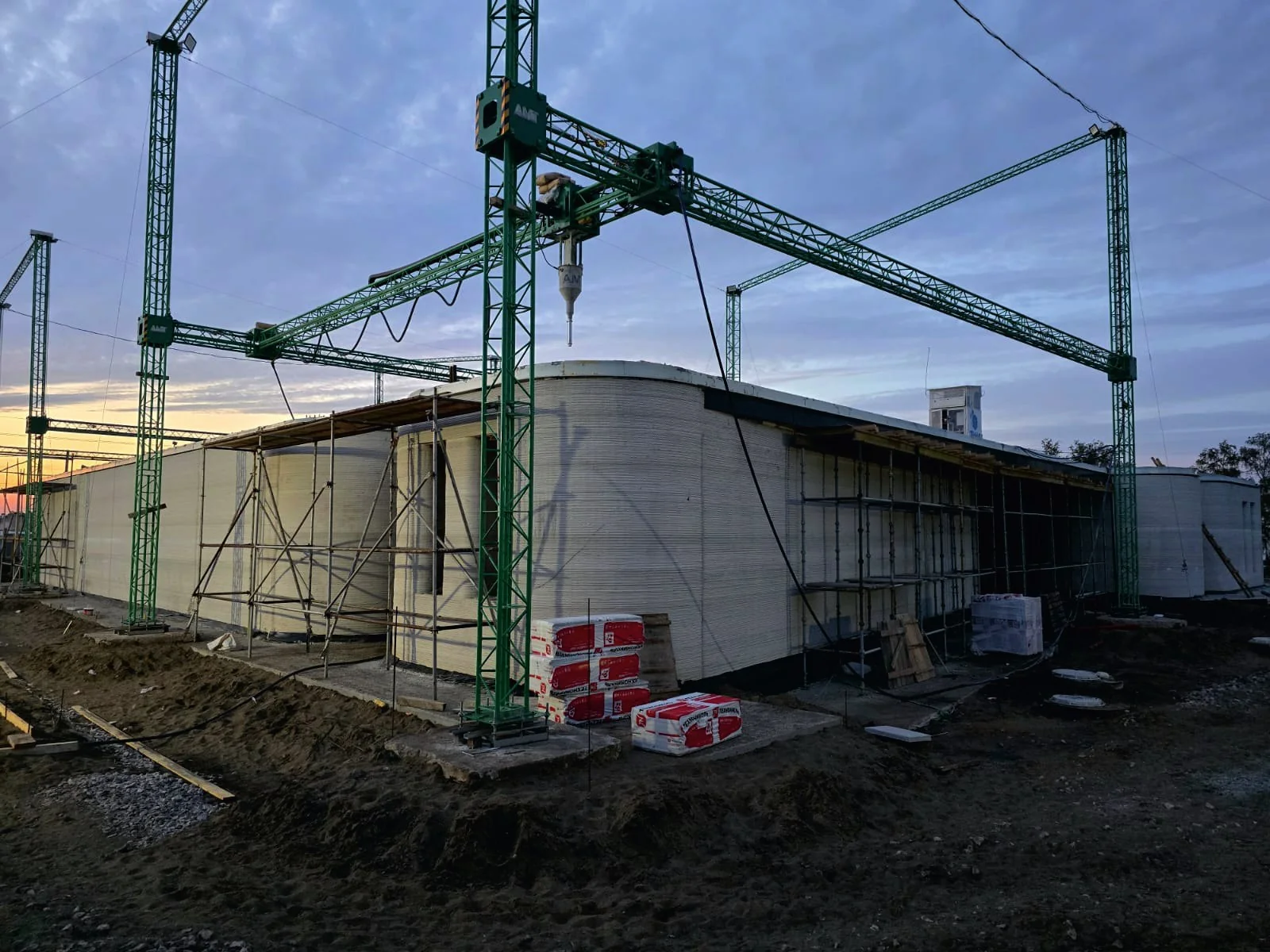
There are two main architectures in concrete 3D printing: gantry systems and robotic arms. Both print buildings layer by layer, but they solve different problems. Choosing the right construction 3D printer starts with understanding what each does best.
The rule of thumb is simple: building something big — you need a gantry system. Need a small house, printed fast — the robotic arm is ahead of everything else. Most buyers already know which problem they have — the guide below makes the trade-offs explicit.
A gantry 3D printer works inside a portal frame. The print head moves along the frame's axes, covering a fixed working envelope. AMTG gantry printers range from 12×12 m to 30×30 m — the G4's portal is the largest construction 3D printer in the world.
The strength of a gantry is volume and repeatability. Once assembled — a 12×12 m frame goes up in about four hours with two people — the printer produces complete structures in one setup: walls, facades and architectural details, all from the digital model.
Choose a gantry when the project is a complete building printed in place. The G1 (from $450,000) handles 1–2 storey buildings up to 180 m². The G2 (from $480,000) reaches higher for commercial structures. The G4 (from $680,000) covers the biggest footprints. The F1 (from $250,000) is the workshop version for precast elements.
Gantry printing is also the most repeatable way to produce identical elements: every layer follows the same toolpath, so quality does not depend on the operator's hand. For developers printing the same house design many times, that consistency is the business case.
Logistics differ as well. A gantry arrives as a kit of modules and goes up on prepared ground — no crane, no heavy lifting equipment. A robotic arm arrives as a finished machine. Both are printing within hours of arrival, not weeks.
A robotic arm 3D printer mounts the print head on an articulated arm, which rides on a mobile platform. There is no fixed frame — the machine drives to the site and starts printing where it stands.
The strength of a robotic arm is mobility. The R1 rides on a pickup truck chassis (from $480,000, or $360,000 without the pickup) and drives between sites on public roads. The R2 sits on a tracked crawler platform (from $450,000) and moves across rough terrain around the job site.
Choose a robotic arm when the work moves: infill lots, remote locations, renovation sites, or projects spread across several addresses. Setup is fast because there is no portal to assemble — the machine arrives ready.
For contractors, the R1's road mobility changes the business model: one machine serves several sites in a week, moving under its own power. For rough sites, the R2's tracks go where wheeled machines cannot. Neither needs a prepared pad to start — they print where the work is.
Robotic arms also excel at details and additions: architectural elements, landscape structures, repair work on existing buildings. Where a gantry prints the whole, an arm finishes the parts.
Complex projects with complex architecture are sometimes best printed with two different machines at once: a gantry system for the main volumes and a robotic arm for the parts a fixed frame cannot reach.
Every AMTG system, gantry or robotic arm, ships as a synchronized production unit: the printer, a concrete preparation station, a foam concrete system and a power generator. Printing speed reaches up to 0.8 m³/h, every machine carries a 12-month warranty, and operator training is free.
Both architectures print the same materials — cement mixes with or without additives, gypsum mixes — prepared by the same synchronized station. The choice is about geometry and logistics, not chemistry.
Start from the project, not the machine. A big building on an open lot means a gantry — nothing prints large volumes like it. A small house that has to go up fast means a robotic arm — nothing beats it for speed and mobility. A large development with both conditions points to a combined fleet.
Budget frames the decision too: workshop production starts at $250,000 with the F1, mobile printing at $360,000 with the R1 without pickup, and full on-site gantry printing at $450,000 with the G1.
Still not sure which fits your project? Send your drawings or project description to info@amt-g.net — an application review matches the machine to the project before you spend anything.