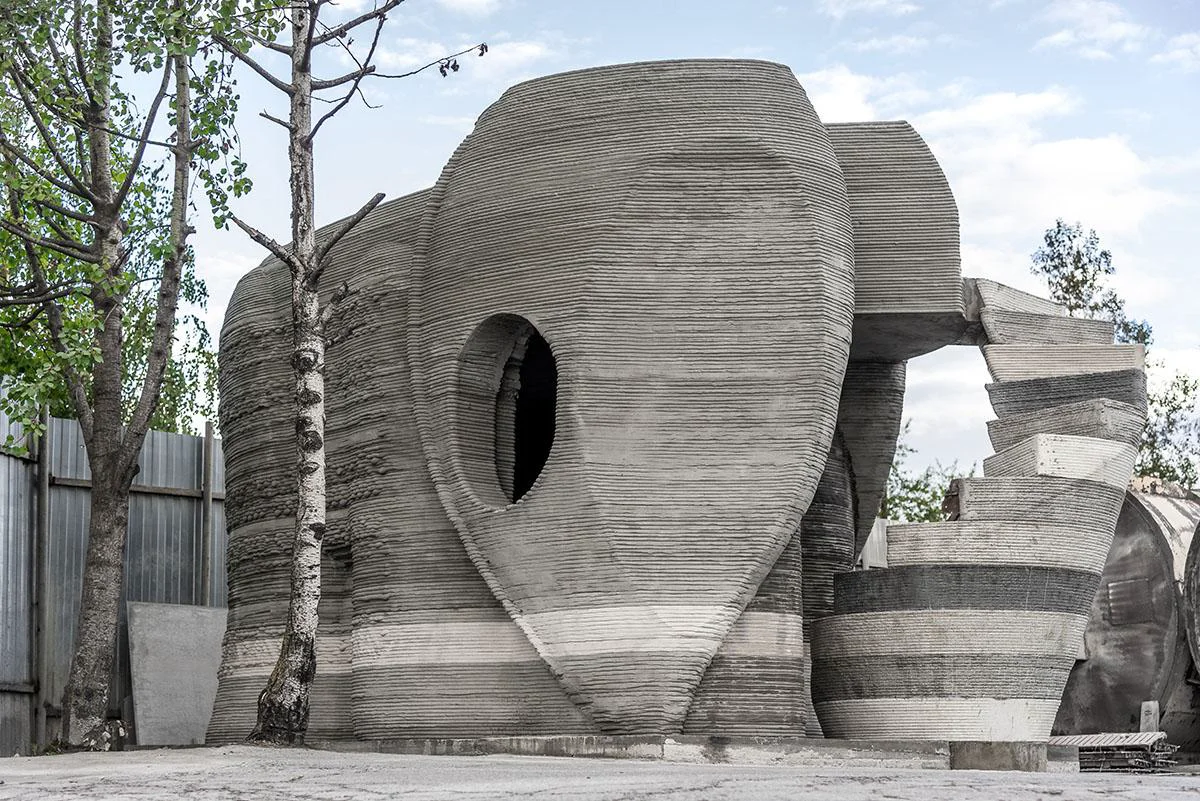
Most buildings are boxes for a reason that has nothing to do with architecture. Straight walls are what conventional construction produces cheaply: bricks come in rectangles, panels come in rectangles, and formwork for a straight wall is a few boards nailed together. The moment a design curves, the economics break — every bend means custom formwork, custom cutting, and hours of skilled labor shaping a mold that gets used once and thrown away. The box is not a style. It is a formwork bill.
A construction 3D printer never sees that bill. The printhead follows a digital file, and the file does not charge extra for a curve: a wall that bends, waves or closes into a full circle is the same toolpath logic as a straight one. There is no mold to build, because the building is printed directly. The projects below show what that looks like in practice — all of them printed by customers on AMTG equipment.
The Dome House is exactly what it sounds like: an organic, dome-shaped building printed layer by layer in concrete. In conventional construction a dome is a specialist project — the formwork for every ring of the shell has to be fabricated individually, and the crew assembles a structure whose only job is to be demolished after the concrete sets. Printed, the dome is simply the shape in the file. The printer lays down each circular layer on top of the last, and the formwork is never built because it never exists.
The Elephant House takes the same logic further: a building sculpted in the shape of an elephant, printed in concrete. Nobody would attempt that shape with molds — it would mean sculpting a full-size negative of an elephant first, in another material, at full cost, before pouring a single wall. For a printer it is a longer file, not a different technology.
The same applies at smaller scale: the Cat Kitchen, a kitchen structure shaped like a cat, shows that sculptural concrete is not reserved for landmarks — detailed, playful forms come off the same equipment as ordinary walls.
Freedom of form is not only for art objects. The Mella shopping center — a commercial building whose wall system was printed with three synchronized AMTG G2 printers — was designed with curved corners, long elevations, openings and architectural transitions, all formed directly from the prepared print files.
At that scale, curved geometry in conventional construction would have meant a custom formwork program running alongside the build. Printed, the curves were part of the standard digital workflow, while conventional teams completed the structural systems, utilities and finishes around the printed shell.
The least exotic example may be the most telling: a customer-printed guest house with curved concrete walls. Nothing about the project is a monument — it is a compact residential building whose architect simply did not have to straighten the walls to make the budget work.
That is what changes when geometry is free: curves stop being a luxury line item and become a normal design decision, available to a guest house on the same terms as to a shopping center.
Printed freedom has boundaries, and they are worth stating plainly. The printer produces the wall system — foundations, roofing, windows, utilities and finishes still come from conventional trades, as they did on every project above.
Curves also have to be engineered, not just drawn: loads, openings and overhangs are calculated the same way as in any concrete structure, and a shape the software can draw is not automatically a shape that stands up. And AMTG’s role in these projects is the manufacturer’s: we supply the printers and support the equipment owners — the buildings are designed and built by our customers.
Within those limits, the point stands. For a century, the rectangle won because it was cheap to mold, not because anyone preferred living in it. When the wall is printed from a file, the shape of a building becomes a design question again — and a dome, an elephant, or a quietly curved guest-house wall costs no apology at all.
If you have a project whose geometry conventional construction keeps pricing back into a rectangle, send the drawings to info@amt-g.net. We will review the design against the right machine — gantry or robotic arm — and tell you honestly whether printing it makes sense.